
- Accessories
- Arduino Development Boards
- Arduino Modules
- Audio Amplifiers
- Battery Controllers
- Big Display Boards
- Car Video Players
- Cooling System
- Counters
- Electronics Gadgets
- Ice Cream Music Box
- Industrial Circuits
- IOT Boards
- Monitors
- Motor Drivers
- Sensors
- Speakers
- Student Projects
- Timers
- Uncategorized

Arduino Leonardo Board
₨1,500.00
Brand:
The Arduino Leonardo is a microcontroller board based on the ATmega32U4 microcontroller. It’s part of the Arduino family and is known for its native USB capabilities, allowing it to emulate a computer keyboard or mouse. Here’s a brief description of the Arduino Leonardo board:
Share:
The Arduino Leonardo is a microcontroller board based on the ATmega32U4 microcontroller. It’s part of the Arduino family and is known for its native USB capabilities, allowing it to emulate a computer keyboard or mouse. Here’s a brief description of the Arduino Leonardo board:
-
-
- Microcontroller: ATmega32U4
- Operating Voltage: 5V
- Input Voltage: 7-12V (via the Vin pin or USB)
- Digital I/O Pins: 20
- PWM (Pulse Width Modulation) Pins: 7
- Analog Input Pins: 12
- DC Current per I/O Pin: 40 mA
- DC Current for 3.3V Pin: 50 mA
- Flash Memory: 32 KB (of which 4 KB used by the bootloader)
- SRAM: 2.5 KB
- EEPROM: 1 KB
- Clock Speed: 16 MHz
- USB Interface: Yes, ATmega32U4 has a built-in USB communication module
- Built-in USB Communication: The native USB allows the Leonardo to emulate a keyboard or mouse, making it ideal for projects where human-interface devices are needed.
- Reset Button: A reset button is available for restarting the sketch.
-
One distinctive feature of the Leonardo is its ability to act as a USB human interface device (HID), allowing it to emulate a computer keyboard or mouse. This makes it suitable for projects where you want the Arduino to interact with a computer by sending keystrokes or mouse movements.
Related products
977 in stock
ARDUINO UNO R3 BOARD WITH CABLE
₨1,850.00
Arduino Pro Micro
₨1,500.00
Arduino Nano Without Cable
₨800.00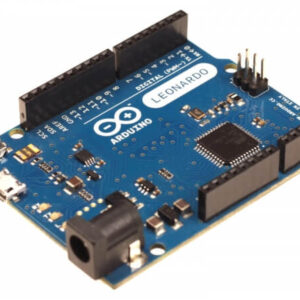 Arduino Leonardo Board
₨1,500.00